From Well-being to Fitness: Why the Language Is Changing
Abstract
Over the past two decades, emotional well-being has emerged as a discipline distinct from mental health, yet the two still share a vocabulary shaped by a reactive, clinical model that sees a person only once something has broken. This article introduces the Center for Emotional Well-being's shift in public language from emotional well-being to emotional fitness and explains why it matters to readers. Drawing on Emotional Intelligence 3.0®'s distinction between the emotional shadow and the psychological shadow, it locates the difference between emotional health and mental health in a single variable, the flexibility of identity, and shows that the nearly universal first condition has had no discipline of its own, a void self-help has tried to fill without accurate language or science. It then contrasts the hospital model with the gym model, arguing that the fitness frame lowers the stigma of looking, replaces diagnosis with development, and turns emotional self-regulation into a capacity that can be assessed and trained. The Center keeps its name and its science; the word for the work changes.
Keywords
emotional fitness · emotional well-being · emotional health · mental health · emotional shadow · psychological shadow · identity flexibility · emotional safety strategies · emotional intelligence
Table of Contents Show
Two Shadows, One Origin
For the last two decades, emotional well-being has been quietly separating itself from mental health and becoming a discipline of its own. Most people have not noticed, because the two still share a vocabulary. But they are not the same thing.
Emotional Intelligence 3.0® names that difference precisely: the emotional shadow differentiated from the psychological shadow. Both come from the same place, an unresolved threat to emotional safety in youth. Both distort identity to stay safe. Figure 1 lays them side by side.
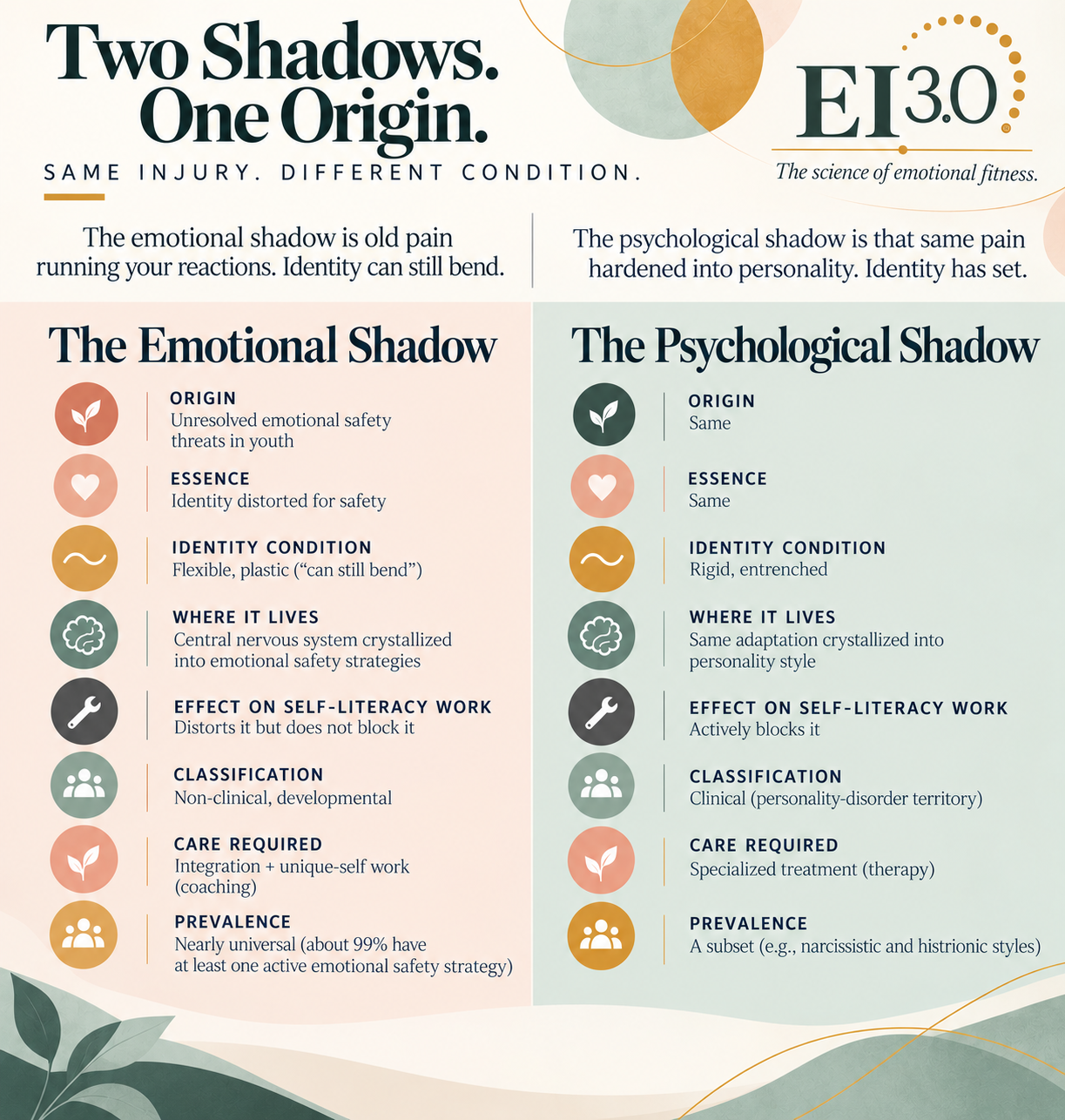
Figure 1. Shadow Comparison
Read down the two columns, and one row decides everything: identity condition. In the emotional shadow, identity is still malleable. It can bend. In the psychological shadow, that same pain has hardened into personality, and identity has set. The first is nearly universal, developmental, and non-clinical; between 96-99 percent of us carry at least one active emotional safety strategy. The second is a subset, clinical territory, and belongs to specialized treatment.
Mental health has always been the discipline of the second column. The first column, the one almost everyone lives in, had little discipline at all. Into that void stepped self-help. For years, it has tried to fill the space between fine and diagnosed, without accurate language or coherent science underneath it, often without knowing what it was trying to do. Strip away the covers and every self-help book makes the same promise: this will help you be a better person. That promise, made precisely and backed by science, has a name: emotional fitness.
The Center for Emotional Well-being is changing the word it uses for what it does. Not the name over our door, but the language for the thing itself. We are moving from emotional well-being to emotional fitness. This article is about why that one word matters, and why it matters most to the person in the first column, who has been standing outside a door that was never built for them.
The Hospital Model
For most of the last century, emotional life ran on a hospital model. It was reactive by design. You waited until something broke: a depression, a burnout, a panic attack that arrived in a grocery store aisle- and then you found a professional to fix it.
Nothing about that model was malicious. It improved lives and still does. But it had a built-in flaw for the rest of us: it only gave you a name once you were “broken.” Below the threshold of diagnosis, there was no language, no practice, no place to go. You were simply fine, whatever that meant, until the day you weren't.
So most people learned to manage. We managed stress, managed anxiety, managed the same argument with the same person for twenty years. Managing is what you do when the only alternative on offer is treatment. It is a holding pattern, and it quietly exhausts the people who are best at it.
And the word for all of this, mental health, came to mean its own opposite. Say it, and people hear illness. That is the sick-care stigma: not a stigma about being unwell, but a stigma about even looking.
The Gym and the Hospital
Emotional fitness turns the hospital model on its head. It treats your emotional life the way we now treat physical fitness: as something you train on purpose to build strength before the crisis, not to recover from it after.
Consider what the word fitness already does for the body. You typically don't go to the gym because something is broken, although you can. You typically go to get stronger. Nobody is embarrassed to be seen training; a person on a treadmill at 6 a.m. is admired, not pitied. The gym has no waiting room, no intake form asking what is wrong with you, and no threshold you must fall below to be admitted. It has a door, and it’s open to everyone at every level.
That is the whole shift, in one image. The hospital asks What is wrong with me? The gym asks How can I get stronger today? Same human. Same nervous system. A completely different relationship to it.
The rebrand is already underway. People who would never book a therapist will download a training plan. Companies that shied away from mental health budgets will fund fitness. The word lowers the cost of showing up, and showing up is where everything begins.
From Diagnosis to Development
A rebrand is only worth anything if the thing underneath it is real. So here is what we mean, precisely.
Emotional fitness is the capacity to meet yourself, other people, life, and the system you're part of without getting tangled in them—to stay present and responsive rather than hooked, flooded, or shut down—and to hold that ground when the pressure is on. It is a condition, not a trait: built one fully felt-through emotional cycle at a time, revealed most often under load, and trainable at any age.
Read that definition next to the hospital model and notice everything it refuses to do. It does not diagnose. It does not sort people into well and unwell. It does not treat your emotional patterns as symptoms of a disorder; it treats them as the current state of a capacity, the way a coach treats your time running your first mile.
This is empowerment over diagnosis, and it changes what you do on an ordinary Tuesday:
• Self-regulation becomes a skill, not a verdict. Losing your temper is a rep that went badly, not evidence of who you are.
• Emotional muscle is built, not bestowed. Resilience, balance, and repair are practices with progressions, like strength and endurance.
• Optimization replaces rescue. The question is no longer How do I stop feeling this? but How do I perform and feel better today?
No one is broken. No one needs to be fixed. Everyone is somewhere on a path, and the path has a next step. That sentence struggles inside the hospital model. Inside the gym, it is simply the truth.
Why the Center Is Changing Its Language, and What Stays
We did not arrive at fitness by following a trend. We arrived at it because, after six years of research, it was the only word that described what we had actually found.
Emotional well-being is a state. It is what it feels like to remain intact inside an emotional storm. It is real, and it is still the name over our door. But you cannot train a state directly, any more than you can train feeling healthy. You train the capacity that produces it. For years, our public language named the destination and left the road unnamed, and a reader could be forgiven for thinking well-being was something you either had or lacked.
Fitness names the road. It is trainable and measurable, and it is never a diagnosis. An assessment tells you where you stand on a continuum; a diagnosis tells you which category you belong to. Fitness only ever does the first. It says the same thing about your emotional life that the last thirty years said about your body: your current condition is information, not identity, and every condition has a next level.
Here's what changes and what doesn't. The Center for Emotional Well-being keeps its name and its science. Our instruments, our Journal, and our research program continue. What changes is the word we use for the work, and for the destination we invite you toward. Well-being is what you will feel. Fitness is what you will build. We are choosing to talk about the building.